Where is the world rich in feedback?

As Ilya said at NeurIPS, we only have one internet. Once the fossil fuel of existing human-generated data has been consumed, further AI progress requires new sources of information. Broadly speaking, this can happen in two ways: search against a verifier, which trades compute for information, or through direct observation and interaction with the world. So if you want to predict medium-term AI progress, ask “Where is the world rich in feedback?”

There are two major dimensions for scaling AI: pre-training, and inference time scaling1. The most recent cycle of AI progress has been driven by inference time scaling (OpenAI O1). These models are trained with reinforcement learning (RL), which requires a reward signal. Reward is much easier to specify in some domains than others, which is why O1 shows huge performance gains in math and code (domains with verifiable right answers), but little to no improvement in more subjective areas such as writing.

Scaling pre-training with synthetic data is almost the same problem. For generated data to be a net win, you need some quality signal to filter it. So essentially all AI progress now turns on availability of scalable quality/reward signals2.

A skewed pattern of AI progress is therefore likely to persist in the medium term. The graph below shows some areas which have faster and cheaper sources of reward. Those seems like a good bet for where AI will move fastest3.
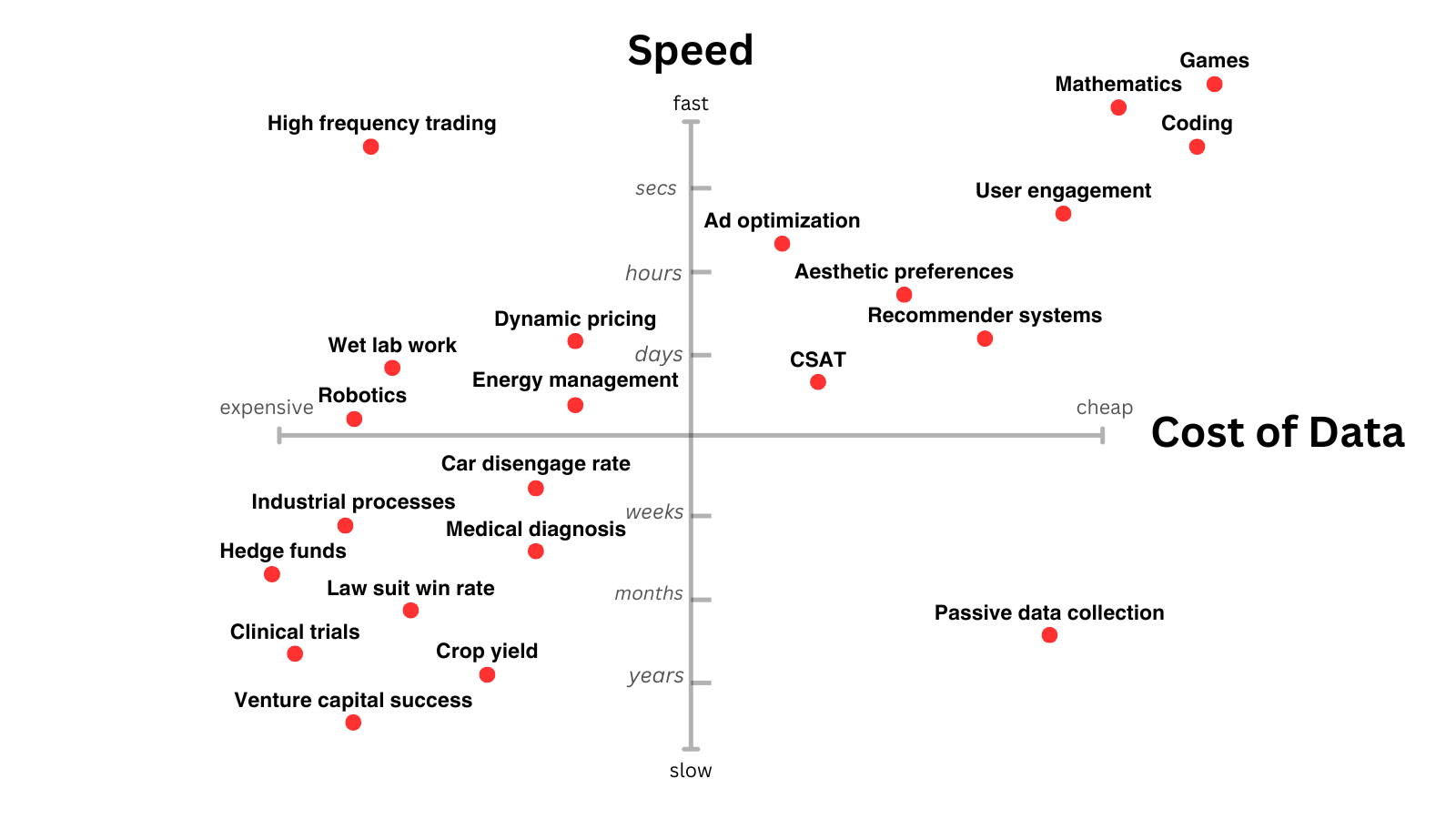
Where is the world rich in feedback?

I’ll dig into a few of these areas, and then speculate about how some problems with less precise reward might be addressed.

More

Investing for the Singularity

The previous post looked at how you might invest for a scenario where AI can do most white-collar work (AGI, roughly speaking), without being broadly superhuman (ASI). However, a short1 transition from AGI to ASI seems plausible, even likely under certain conditions. My focus on the simpler AGI scenario is partly a case of looking for the keys under the streetlight. So in this post I’d like to think through how to invest for a full ASI scenario.

More

Investing for the AI transition

At this point it seems basically certain that AI will be a major economic transition. The only real question is how far it goes and how fast. In a previous essay I talked through four scenarios for what the coming few years might look like. In this essay I want to think through how to invest against those scenarios.

More

How much LLM training data is there, in the limit?

Recent large language models such as Llama 3 and GPT-4 are trained on gigantic amounts of text. Next generation models need 10x more. Will that be possible? To try to answer that, here’s an estimate of all the text that exists in the world.

More

Revised Chinchilla scaling laws – LLM compute and token requirements

There’s a nice blog post from last year called Go smol or go home. If you’re training a large language model (LLM), you need to choose a balance between training compute, model size, and training tokens. The Chinchilla scaling laws tell you how these trade off against each other, and the post was a nice guide to the implications.

A new paper shows that the original Chinchilla scaling laws (from Hoffmann et al.) have a mistake in the key parameters. So below I’ve recalculated some scaling curves based on the corrected formulas.

More